|
The Golden Trout: The most elusive, the most beautiful, and the most coveted.
Why do humans value gold? It seems strange that an elemental metal has fascinated and motivated humans in every culture as far back as ancient Egypt. The malleable, shiny metal is electrically conductive, yet there are better substances for that purpose. Gold has inspired mass migrations of people to California, Alaska, and dozens of international locales. Spanish explorers set gold on a par with God and glory as justifications to conquer other cultures. The modern gold standard even demands that human economies back up their paper currency with closely guarded repositories of gold bars. The reasons why people value gold seem arbitrary; yet, people strive and suffer to attain it. Gold signifies something superior no matter what it is associated with, even trout. Of the six species of trout in California, the golden trout, presumably named for it colors, is the most elusive, the most beautiful, and the most coveted.
Golden trout only live in alpine lakes at elevations of more than 10,000 feet, usually higher. The Wind River Range in Wyoming and the Sierra Nevada Range in California are the two primary habitats of this species. Only a handful of weeks each year affords the opportunity to climb snow free over their rocky spines. Each trip back to the Eastern Sierra was a reminder of the elusive goal. Sprained ankles, weather, and any number of excuses left me with only the longing of next year. This September, my friend accompanied me on this 16 mile round trip trek. We began our hike near the Rock Creek Pack Station at 9,600 feet; we would later ascend a granite crest at 11,800 feet.
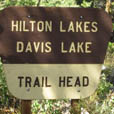
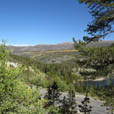
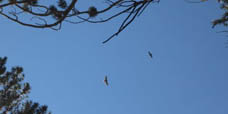
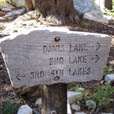
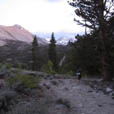
We left in the afternoon. It was sunny and warm. The Hilton Lakes Trail passes through a forest of whitebark and lodgepole pine before it enters the basin of Hilton and Davis Lakes. We crossed six small creeks spaced apart by a half mile of sandy, undulating trail. We had views of the Wheeler Crest across the canyon. The aspen trees that cover its flanks were glowing yellow and orange, and were illuminated by golden sunlight. The weather has forced the trees to drop their leaves in preparation for the cold rain and snow which is coming, but not before the leaves fade from lime green, to lemon yellow, to pumpkin orange, to ember red, to burgundy wine, and finally to molasses brown. Wind blows through them and prematurely spins leaves of all hues to the white sand beneath our feet creating a colorful pattern atop the trail. As we labored up and down the path, we were driven by thoughts of catching golden trout. It was the reason we kept pushing our tired legs up what we call, "Big Sandy," a stretch of seemingly endless uphill grade and loose granite powder footing. Every step took us higher where there was less oxygen, making breathing even more difficult. A pair of Red Tailed hawks circled high overhead. We kept talking about the golden trout to remember why we were here.
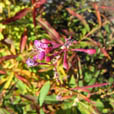
After several hours of walking we came to a rock staircase that descended hundreds of feet into a shady draw. Although it was lined with wildflowers, we resented every step down because we knew that was hard-won elevation we were giving up, and we knew we had to reclaim it farther up the trail, but it was where the trail took us; it was the price of admission. If this was easy, everyone could do it. The feeling of exclusivity had to be worth it. My friend shared stories of the Cabin's that have long since been destroyed. Not by mother nature, but by law enforcement when they found slot machines within their walls.
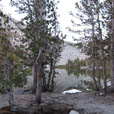
When the descent ended, we climbed back up into Hilton Creek Canyon by way of Big Sandy's evil twin sister, Satan's Staircase. Hundreds of angry rock stairs, some pushing 24" tall, made worse by the additional weight of our backpacks. After four hours we arrived at the stream outlet of Hilton Lake 3. By now it was dusk and we hurried along through heather, laurel, and pine to reach our campsite 5.5 miles from the car, at 10,454 feet along the shoreline of Hilton Lake 4.
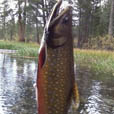
Taking off the packs felt good, our legs did not. We fished here for a few minutes and caught, and released, as many small brook trout as we wanted. They are as voracious as they are beautiful, due to a short feeding season. We hoped the golden trout in the next lake would be as cooperative. After a good meal, darkness fell and we retired to the tent to recover for what lay ahead tomorrow.
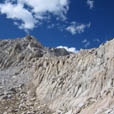
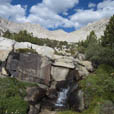
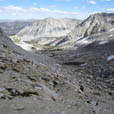
First light woke us up earlier than we were used to, but we were anxious to get going. We ate breakfast, assembled a minimum of gear into smaller packs, and started our climb to the alpine lake that held the golden trout. We had another 2.5 miles of terrain to cover, but it was all up a steep, rocky hill. The climb was not gradual. There was no trail; all route finding was to be done on the spot. Each step demanded we take into account our new orientation and improvise the best way from there. The elevated cirque was strewn with ledges and shelves, bisected by a polar stream of spring water, lined with lush, green meadows erupting with flowers. The view back down the canyon grew increasingly more dramatic with every step up. Our intermediate goal was a granite saddle looming in front and above us just shy of 12,000. The landscape above timberline seemed like a lunar surface, surreal, hostile, alien. Again, our thoughts turned to the golden trout in the lake beyond.
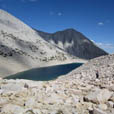
Perseverance drove us up that granite monolith and moved us atop the rocky spine. We paused only to catch our breath, we were close and wanted to push on. Our goal sits on the other side of the divide; so reaching it required us to climb down about a half-mile of car-sized boulders. Patches of snow remained. Spent, we crested a rise and saw the lake; bright blue, oval, completely surrounded by sand and rock - no plants, no trees, no animals, no people.
Even though we hoped that the lake was not as barren as it looked, we hurried down to the shore. The weather was stellar; it could not have been a better day, appropriate for the setting. Through the gin clear water we saw fish swimming, big ones, golden ones. We had arrived. Now all we had to do was catch them. Just being there was exhilarating, but we wanted validation, we wanted to be awarded for our trek. We didn't work so hard to come away empty handed, or with the silvery rainbow trout, we wanted the golden trout.
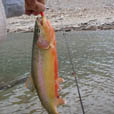
The serenity ended with a large splash. The first fish was beautiful, big, and like the environment, surreal. We caught many others and released them all. As I walked the perimeter of the lake I casted to my heart's content. At the remote end of the lake I hooked and brought to shore the biggest golden trout either of us had ever seen. It released itself and took with it my 30 year old lure. Not many people can say they have done that. I felt fortunate. It is a rare opportunity to access such a treasure, an even rarer one to be successful.
We thanked the fish and the mountains as we started our long trip back to camp. It was grueling but again, we thought of the prestigious experience and knew that we had to pay for it. We made camp in two hours, donned our larger backpacks and hit the trail back to the car. It felt longer coming out, and as crazy as it sounds, that trail was uphill both ways. We arrived at the car four hours later, just as it was getting dark. It was a remarkable 30-hour journey to find the golden trout, I was grateful to have attained my goal. As we neared the conclusion of the trek, I remarked to my friend, "Let's never do that again." A reference to the toll the trip exacted on our tired bodies. But as we reminisced about our adventure the next day, I asked, "When can we plan our next trip?"
Nothing worthwhile comes easy; the golden trout is no exception. I understand now that its name derives not just from its brilliant color, but from the ideal that gold is valuable, coveted, and difficult to obtain, yet worth the effort. |